Sometimes in running the weather conditions will necessitate that we adjust our running paces in order to still accomplish our goals for the run without overdoing it. This post will help you work through how do just that.
Pace Adjustments For Hot/Humid Weather
The body makes several physiological adjustments to cool itself in overly warm conditions, and especially in warm & humid conditions. These adjustments cause less blood & energy to be available for use in our runs and workouts. So to compensate for this it become necessary to adjust our pace expectations for our runs. Failure to adjust for these conditions can lead to failed workouts or over training.
Below are the amounts you would slow your pace ranges based on the warm/humid conditions. After multiple weeks of regular exposure to these conditions your body will become acclimatized and you can reduce adjustments. To use the chart below you must know the air temperature and the dew point in Fahrenheit, common measurements you can find on most any weather app.
Note: Heart Rate ranges will not change but those ranges will produce a slower pace.
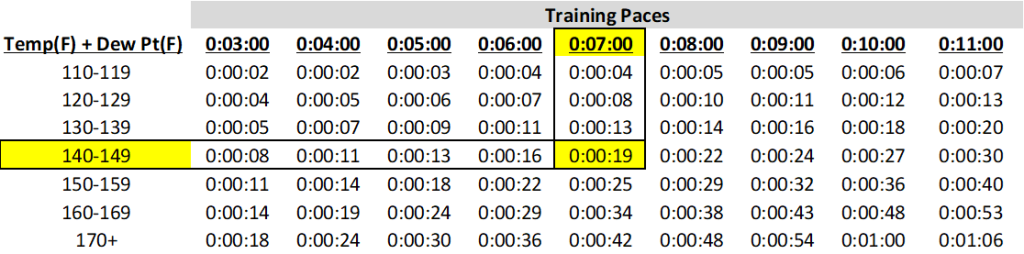
Example: If temperatures outside are air temperature of 75°F with a dew point of 70°F at workout time.
We add together the two temperatures (75 + 70 = 145) and look on the chart of the adjustment amount
If your schedule calls for 4 mile Tempo Run @ 7:00 pace then your weather adjusted pace would be 7:19 pace. If these conditions persist for multiple weeks as you acclimatized your adjust would diminish to maybe 7:10 pace.
For those of you (geeks like me) who want to do the math yourself. Simply slow your paces by:
- 1% for combined temperature and dew point of 110-119
- 2% for combined temperature and dew point of 120-129
- 3% for combined temperature and dew point of 130-139
- 4.5% for combined temperature and dew point of 140-149
- 6% for combined temperature and dew point of 150-159
- 8% for a combined temperature and dew point of 160-169
- 10% for combined temperature and dew point of 170 or more
Adjusting Paces for Extreme Cold Weather
Adjusting our paces for extreme cold weather is less formulaic then it is for the warm weather but is still necessary. Here are a few considerations and recommendations to keep in mind when running in conditions below 32º F (0C).
- In cold weather we often dress in layers and the extra clothes can cause extra weight and restriction of or resistance to movement, so some pace adjustments may need to be made.
- Allow the body more time to get warmed up & operating at peak efficiency, this means easing into runs more gradually or for a few additional minutes then you would in more ideal temperatures.
- In temperatures below 20ºF (-7C) the body often restricts blood flow to the extremities to keep the core warm, which can necessitate an adjustment in (slowing of) training paces.
Windy Conditions
When running into a significant headwind you will need to slow your pace expectations as resistance has increased. Fighting too hard to hit original paces will cause the body to work harder than the zone we desire for that run or workout.
Similarly, when running with a tailwind you can increase your speed expectations a little. Both adjustments are necessary & expected.
No Worries
I know for many adjusting training paces can cause anxiety and a feeling like you are cheating or wimping out. I assure you that is not the case. The weather is necessitating the adjustments and your body will get the same appropriate benefits from the adjusted paces as it would doing the original paces in better weather conditions. But if we do not adjust for weather and stick to original paces we will often find ourselves over training and not getting what we should from our efforts.